In the last blog I claimed that consciousness is an emergent property of a complex information system and that conscious experience is caused by our mental model observing itself recursively. To Chalmers’ question what is it like to be conscious I’d have to answer, well, actually, it’s like having a little man in my head observing everything going on in there!
So have we solved the Hard Problem? I’m not sure. I suspect Chalmers would say no. But I think we’re on the right track. And like Chalmers, I have a hunch that the concept of Information is key to the problem. Perhaps instead of information we should talk instead of “knowledge” to capture the idea of something which belongs to someone and is persistent over time and grows. Consciousness could then be summarised as “knowledge which is aware of itself”.
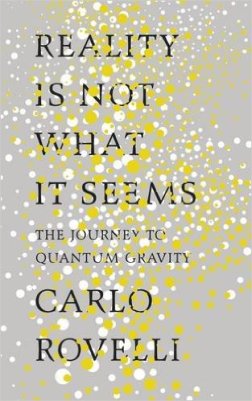
In this blog I’m going to start exploring how the Model Theory of what happens inside our head relates to what modern physics tells us about what happens in the physical world outside our head. In this respect, as part of a lifelong attempt to understand quantum mechanics, relativity and so on, I’ve been reading an excellent book by Carlo Rovelli entitled “Reality is not what it seems – the journey to quantum gravity”. I still don’t understand it! But I’ve learned some fascinating new things.
If, as I claim, consciousness is “just” information, albeit information configured in a highly complex and specific manner, then it’s tempting to speculate that perhaps everything else in the universe – matter, energy, space, time – is “just” information too. Well it turns out that this is not a new idea. A very eminent physicist called John Wheeler came up with the concept of “It from Bit” many years ago. To quote: “It from Bit symbolises the idea that every item of the physical world has at bottom — at a very deep bottom, in most instances — an immaterial source and explanation; that what we call reality arises in the last analysis from the posing of yes-no questions and the registering of equipment-evoked responses; in short, that all things physical are information-theoretic in origin and this is a participatory universe.”
What this refers to, I think, is something which I’ve never really been able to get my head around – all that business about Schrodinger’s cat and how you can’t say anything definitive about the position or velocity of an elementary particle until it’s been observed (ultimately by a human being, presumably). Similarly, Einstein’s relativity seems to be about observers constrained by the speed of light which has an absolute and, to me, arbitrary value of 186,000 mph. It gets worse! I now learn from Rovelli that at the quantum level neither space nor time really exist! All there is are “events” when elementary particles interact with each other and come into existence. All very weird, but what’s exciting for me is that Rovelli seems to be saying that information is at the heart of it all. For example: “In fact, the entire structure of quantum mechanics can be read and understood in terms of information, as follows. A physical system manifests itself only by interacting with another. … Any description of a system is therefore always a description of the information which a system has about another system.” Also: “Many scientists suspect today that the concept of “information” may turn out to be a key for new advances in physics. … I believe there is something important in this idea.” But he’s kind enough to add in his chapter on information: “If this chapter seems particularly opaque, it’s not because your ideas are confused. It’s because the one with the confused ideas is me.” Phew!
The concept of information is also central to thermodynamics. Recall that the Third Law of Thermodynamics states that Entropy, broadly conceived as the inverse of information, always increases. Except in highly organised local systems such as living organisms or the human mind where entropy is reduced (and information, or knowledge, is increased) by effectively “feeding” on energy from the outside world. Rovelli points out that the only way we perceive the passage of time at the macro level (remember that at the micro level it doesn’t exist) is through the evidence of entropy-increasing processes, like breaking glass, or decaying matter. Is there a connection between the central importance of time to our conscious experience and the notion of the mind as an entropy-reducing, knowledge-creating information system?
To be continued …
 consciousnessandstuff
1 comment