J W Dunne and the infinite regress

I don’t think anyone reads J W Dunne any more, but he was very popular in the 1930s and published two rather remarkable books.   In “An Experiment With Time” he claimed that our experience of time as linear is an illusion of human consciousness, and that in dreams we had simultaneous access to past, present and future.  In “The Serial Universe” he extended this argument to accommodate the then quite recent findings of quantum physics and relativity, and concluded that we are immortal! 

Personally, I don’t buy these claims.  I haven’t read Dunne sufficiently carefully to be able to offer a definitive refutation, but my instinct is that precognition and immortality are just plain wrong.

Dunne did have an insight, however, which I suspect is crucial to the understanding of human consciousness: namely, the idea of an infinite regress

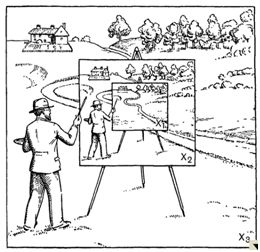
From J W Dunne, "The Serial Universe", 1936

An infinite regress is a series in which the truth of a term N is dependent on the truth of term N+1 and so on to infinity.  They are generally regarded as bad things – if you find yourself resorting to explaining a phenomenon in terms of an infinite regress you are generally regarded as having failed.  Dunne, if I understand him correctly, challenged this dogma – infinite regresses crop up in all sorts of situations and we just have to accept that they are a “real” feature of our universe.  Moreover, he pointed out that in any such series, it is only when we get to the second term that we reach a full understanding of the phenomenon under investigation.  For example in the series child – father – grandfather – greatgrandfather, and so on, it is only with the second term that we get the essential property that each term is both a father to the preceding term and a child of the next term.

In consciousness debates, an infinite regress is associated with the familiar and much derided idea of a “homunculus”, or “little man” who watches a screen on which is projected an image of the outside world, and is in turn watched over by another little man, and so on ad infinitum. 

Homunculi

Ridiculous, obviously!  Or is it?  Actually, it feels to me as if something like this is going on, and it fits in with what is known about the active nature of perception and the phenomenon of selective attention.  If I look out the window, I’m aware of the scene outside, but I’m also aware I’m looking at the scene, and I’m aware that I’m aware, and so on.  And if this goes on to infinity – so what – at least we’ve captured the recursive quality of consciousness as involving something which is both observing and being observed simultaneously.  We’ve also captured the idea of the self as a “model within a model” which can selectively observe different aspects of the model of the outside universe.

Qualia – maybe not such a hard problem after all?

Let’s now tackle head-on the issue of “qualia” – those subjective conscious experiences such as the redness of an apple or the pain of a headache, sometimes referred to as “raw feel”.  The undeniable reality of qualia, coupled with their “ineffability”, has been taken to be a fundamental problem for materialist explanations of consciousness such as the Model Theory.

apple

Well I don’t think so.  In fact I regard qualia as, ultimately, nothing more than information, albeit extremely complex, organised, self-referential information.

If you think about it, there’s lots of other “stuff” in the universe which is not physical matter but is nevertheless “real”.  The contents of a phone directory, a novel like War and Peace, a piece of music, the whole of mathematics.  All essentially information.  Although they are not matter, they are expressed through matter, as markings on a piece of paper, or recordings on a CD, or bits and bytes within a computer.  But they are all more than this – there is something which transcends the physical substrate which in a sense is pure information.  Would this something still exist if there was no human mind to appreciate it?  Yes, I think it would.  Would it still exist if there was no matter, no universe?  Well we’re now getting into very deep philosophical water, but again my answer would be “yes, in a sense”.

Now let’s think about a model or simulation, of, say, a weather system, running on a powerful computer.  The model consists of data structures such as tables of temperature gradients, or wind patterns, all operating on each other according to programmed logic, and running through time to generate a simulated weather system which is in some sense similar to the real thing, except that one has as a substrate the real world – air, water, land and so on – while other has as a substrate the circuits of a computer, and of course is much, much simpler.

Now imagine a much, much more sophisticated computer simulation, or, indeed, the model inside our head.  This model is much wider in scope and complexity, but fundamentally is still information – a vast, interacting set of data structures corresponding to sense data, feelings, memories, symbols, higher level abstractions of physical objects or concepts, and so on.  This is how I conceive of the raw material of qualia.

But hang on you say, “you haven’t explained the conscious nature of qualia – what it feels like to experience redness – I can accept that War and Peace as a story transcends the physical book it is written in, but War and Peace can’t appreciate itself”.  Well, the crucial point about our Mind Model is that it contains a “model within a model” which is the Self.  As the Mind Model runs, the Self sub-model interacts with other sub-models corresponding to entities which have properties corresponding to qualia such as redness, pain, the melody of a song, and so on.  It seems inconceivable to me that this could all go on in some sort of intellectual vacuum, or zombie state without the model itself having access to, experience of, and knowledge of what is going on inside it.  The net effect is consciousness.

OK, it’s not perfect, but to my mind, at least, it’s a reasonable explanation.  Legions of philosophers have of course agonised over this issue, but I think they get hung up on arcane “thought experiments” and just make the whole thing too complicated.  I may return to the vexed question of qualia, but for the time being my working hypothesis is that the Mind Model is in essence an extremely complex information system and that consciousness is an emergent property arising out of the self-referential features of the system.

Meanwhile, an intriguing thought.  In some ways, by conceiving of mind as consisting of information, which exists in a physical substrate, the brain, we are in a sense reverting to a duallist notion insofar as information is distinct from matter.  But what if all matter was ultimately information.  More on that later!

Overview of the Model Theory in action

I’m looking out of the window and I’m conscious of the street outside and I’m also conscious of the fact that I’m looking at the street as well as lots of other things going on outside me and inside me.

Here’s what I think is happening.

Inside my head, running on my brain, is a model, or simulation, of everything.  It includes what I see on the street, everything else I sense about the outside world or the inside world of my physical body, everything I know, in the form of memories, and crucially, it includes a model of myself, as a subset of the overall model, which interacts with the model I have of the universe.

It seems to me that this theory explains, or is at least consistent with, most of what we know about human psychology; in brief:

Self-consciousness.  The idea of self as a “model within a model” is intrinsic to the theory.  If consciousness is an expression of the running of the model, then self-consciousness is inevitable.  [Note: this is both the easiest and most difficult part of the theory, and I’ll return to it; note for the moment that it ties in with Douglas Hofstadter’s idea of recursiveness or “strange loops”].

Perception.  One thing which is very clear from decades of psychological research is that sensory perception is an active rather than a passive process.  In other words what I consciously experience when I look out the window is not so much sensory data streaming into my eyes, but rather a much simpler, more abstract, internally generated model, with most of the detail filtered out.

Attention.  Central to the idea of active perception, and indeed to consciousness itself, is the concept of attention.  As I look out at the street, I’m able to focus successively on a particular tree, or a car, or the street sign.  More generally, either consciously or unconsciously, I’m continually shifting attention from one part of the model to another, driven either by external events or internal drives or aims or indeed sequences of thought.   What’s mainly going on here, I believe, is a process of testing hypotheses about the outside world – a kind of generalised “corollary discharge” (of which more later).

Drives, feelings, emotions …  As a biological animal I am driven by physiological impulses or drives such as the “four Fs” (fight, flight, food and reproduction!) and the model in my head has evolved to satisfy these drives and maximise my chances of survival.  Feelings and emotions are simply the conscious expression of these drives.  It would be exceedingly odd if the model, and particularly the model within the model corresponding to the self, did not have access in some way to the things which were driving it.

Purposive behaviour.  My stomach is rumbling, I feel hungry, and I’m starting to think about lunch.  In my head, I run a little simulation in which I get up, go to the kitchen, open the fridge, make myself a bacon sandwich, and so on.  Model theory fits very naturally with this sort of purposive behaviour and can be generalised to most other forms of planning and human activity.

Memory and time.  The model is a process which runs over time and operates on memories in a similar way that a computer simulation operates on data.  There’s a lot more to be said on this subject, but note for the moment that memory and time, which are of course central to consciousness, are also intrinsic to the model theory.

Language and narrativeLanguage is conceived of as a particular and particularly abstract expression of the model.  In a sense, language is a model, and of course, there is a close correlation between language and thought.  Similarly, narrative in all its forms – storytelling, books, films – can be regarded as a form of modelling.  The fact that we respond so naturally to storytelling, and so easily become absorbed in a good story, fits well with the idea of a corresponding model in our heads.

Dreaming.  When we sleep, our model continues to drive itself, influenced by memories, emotions, but largely cut off from the external world.  We experience this as narratives which we call dreams – in some ways the purest form of the model.  Note that the sub-model we call the self is almost always present within our dreams.  A Finnish researcher called Antii Revonsuo has written persuasively on this subject, but he doesn’t seem to have made the leap to consciousness as a whole.

The Model Theory of Consciousness

OK, let’s jump straight in.

Inside each person’s head is a model of everything outside.  This model of the universe “runs” in the physical brain, in the same way that a software program runs on a computer’s hardware.  Now here’s the crucial bit: obviously, the model contains within itself a model of the person to whom the brain belongs – the self.  The running of this model within a model is what we experience as consciousness.

That’s it really.  In subsequent posts I hope to show how this simple theory fits nicely with most of the things we know about consciousness and the human condition.  Note, for the time being, some key features of the theory:

  • There is no distinction between mind and matter*.  In philosophical terms, this is a monist as opposed to a dualist theory.  Thinking and consciousness are regarded simply as emergent properties of a highly evolved biological system.
  • Similarly, we do not need recourse to unlikely concepts such as God, the soul, or other forms of mysticism.
  • In principle, a similar model could run on a physical substrate other than the human brain, for example a highly sophisticated computer.  So here’s a testable prediction: eventually we will see conscious computers.

I hesitate to claim that this is an original theory.  I know that others have entertained similar ideas in fields such as philosophy, psychology, neuroscience and artificial intelligence, but I’m not aware of any attempt to bring these strands together in a single, complete, coherent account, and conversely, I’m not aware of any definitive refutation of such an account.  Hence this blog.

Rene Descartes
* Rene Descartes would beg to differ.