A blog is born!
This is my first blog. For many years I’ve been speculating idly about consciousness and stuff, and I wanted to share those thoughts.
I’m not an expert in the field. In another life I used to be an academic psychologist but I moved successively into operational research, computers, banking and card payments. I’m now an independent management consultant, based in London, the wrong side of 60, and looking for an audience – which now includes you!
Blogging seems like a great vehicle for a dilettante who likes the sound of his own voice. I approach it in roughly the spirit I imagine Montaigne must have published his essays in the 16th century. Here’s a few of his quotations:
- “Que sais-je? (What do I know?)”
- “I speak the truth, not so much as I would, but as much as I dare; and I dare a little more as I grow older.”
- “Whoever will be cured of ignorance, let him confess it.”
- “No-one is exempt from speaking nonsense – the only misfortune is to do it solemnly.”
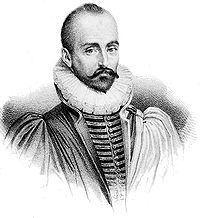
Michel de Montaigne
More About Me
Some more details about me and my history may help to put in context my “Model Theory” of consciousness described in the main part of this blog.
I was interested in the biological sciences from an early age and I was fortunate enough to read Natural Sciences at Cambridge from 1969 to 1972. This meant I was able to shift my main academic focus rapidly from biochemistry, through physiology, to psychology in my last year. I loved studying psychology, not least because no-one really knew much about it, so one’s own ideas were as good as anyone else’s. As far as I’m aware that’s still largely the case today!
I went on to do a Ph.D in Experimental Psychology at Oxford. My thesis was entitled “The Role of the Frontal Eye-Fields and Superior Collicili in the Visual Behaviour of Rats and Monkeys”. The main hypothesis I was testing was that these parts of the brain are involved in maintaining visual stability through a “corollary discharge” mechanism. More about this in the blog. My experiments provided absolutely no evidence for this specific hypothesis! However, I never really abandoned the idea and concluded that “the frontal eye-fields have a command function in the organisation of co-ordinated shifts of attention. The attentional mechanism underlying this function is thought to be that of a repeated testing of an internalised schematic map of the environment against afferent sensory information.” I still believe this to be more or less true and as you will see it is entirely consistent with the more general Model Theory. But I remember being criticised for including this statement in an otherwise perfectly respectable thesis because it “went beyond the evidence”. Remember that this was at the tail end of the dark days of Behaviourism – memorably dismissed by Noam Chomsky as “the science of meter readings” – and responsible, in my view, for blighting a whole generation of psychological research.
When I started my Ph.D I intended to become an academic psychologist and I fondly imagined I would be part of a golden age of neuroscience which would explain in detail how the brain works and provide a definitive understanding of concepts such as mind and consciousness. Four years later I was disillusioned. The prevailing behaviourist mindset meant that consciousness could barely be discussed, let alone studied. I also realised that the subject was far more complex and difficult than I’d supposed. And I found that academic research was actually quite a lonely endeavour and required a motivation and focus which didn’t come naturally to me. So I looked around for a job in the real world!
Fortunately the National Coal Board (NCB) at that particular time had a policy of recruiting a few people with “odd” academic backgrounds into their Operational Research (OR) group, which was otherwise dominated by mathematicians. OR can be loosely defined as the application of scientific methods to business problems. I don’t think anyone does it any more, or it has been subsumed into more general disciplines such as management science or systems analysis, but in those days it was thriving and the NCB, a massive nationalised industry, had the largest OR group in the UK. That’s where I ended up!
My biggest project at the NCB was to build a computer model of the manpower requirements for building and growing a new coal mine. This was fascinating! Computing was still fairly primitive in those days. To run a program we had to feed a huge deck of punched cards into a reader which communicated in batch mode with a mainframe up in the Midlands and if you were lucky you got a printout back in the morning. So actually building a computer model was mostly a matter of working it out with pencil and paper. I recall that several weeks into the project I realised that I’d forgotten to include any inputs or outputs! The model existed only as some sort of abstraction – in my mind and as a symbolic system on paper. As you will see in the blog, I’ve remained fascinated by the question what exactly is a computer simulation and my hunch is that the conscious mind is a similar phenomenon.
One last anecdote from my NCB days, although it’s got nothing to do with models or consciousness. My very first project was to assess the effectiveness of the so-called “subsidised appliance campaign”. The campaign was a fairly straightforward marketing exercise. By subsidising the buying of fireplaces and coal-fired boilers, it was intended, reasonably enough, to encourage consumers to burn more domestic coal. I designed and organised a survey and wrote my very first computer program (in PL/1!) to analyse the results. These proved conclusively that the campaign was a success – consumers did indeed burn more coal. Almost as an afterthought, I then tried to put a monetary value on the result by feeding in the profit we made per ton of domestic coal. This figure proved strangely difficult to establish. You’ve probably guessed what came next – it turned out that we made a significant loss! So not only were we digging the stuff out of the ground at a loss, but then we had a whole marketing department to help lose money faster, and we employed people like me to make the marketing department more effective! I’m afraid this completely destroyed my faith in nationalised industries and I remain to this day a free market, small government bigot a la Friedrich von Hayek.
I’d been interested in computers ever since reading a book published in 1973 entitled “Electronics: A Course Book for Students” by G.H. Olsen. This contained the following extraordinary statement: “There is little doubt that the historian of the future will see the monolithic integrated circuit as the most important advance ever made in technology”. Wow! So having had my first taste of computers at NCB, as a user, I left to join GEC Computers Ltd, now long gone, determined to find out how they worked. I remained completely baffled for about six months then it all clicked. Computers are actually quite easy to understand once you grasp the principle of very simple elements combining onion-like in layer after layer of increasing sophistication to generate the almost mystical emergent properties we see today in our PCs and smartphones. As you will see in the blog, I regard the brain, mind, and consciousness as arising in a similar process of emergent evolution.
After a few years, I had the outrageous idea of reinventing myself as a management consultant and that’s what I’ve been ever since, first with Ernst & Young (EY), then with Stanford Research Institute (SRI), and for the last 20 odd years working on my own as Collin Consulting Ltd. Once again I was completely out of my depth in the early years. I started off as an IT consultant, then specialised progressively on banking technology, payment systems, card payments and latterly smart cards using EMV chip technology. I sometimes call this progression my “Willie Sutton” approach to career development – Willie Sutton was a US gangster who, when asked why he robbed banks, replied “because that’s where the money is”!
The banking industry gets a bad press these days but I’ve always enjoyed my involvement in it and I’ve been fortunate enough to have worked on some really ground-breaking developments over the years such as cashless shopping, internet banking, e-commerce, and smartcard payments. One of the things which impresses me about banks, especially in the payments industry, is the way they simultaneously compete and collaborate on a global scale to make these massive, complex, technology developments work. Call me fanciful, but I see a parallel between the way these complex financial systems generate baffling “emergent properties” such as money, wealth and economies, and the way in which an even more complex system, the human brain, generates the ineffable phenomena of mind and consciousness.
 consciousnessandstuff
Thanks Anonymous. I did check out the Chase Hughes YouTube and you’re right – Neuroscience is finally really taking off with extraordinary new techniques allowing us to really see microscopic changes happening in the brain at an incredible level of detail. I reckon the new evidence is entirely consistent with the Model theory of Consciousness in the main part of this blog – what do you think?
Check this out Nick
Chase Hughes’s engineered virus. “Neuroscience just did the impossible.”
a video Shel just showed me on YouTube