How time flies. I finished the last post with the words “To be continued” and now I find it’s three years later! But in the meantime I’ve been doing a lot of thinking and reading, especially about quantum physics, and in this respect I’ve just finished a really good book called “Beyond Weird”, by Philip Ball, which has prompted me to revisit this blog.
So, to continue… Having convinced ourselves that consciousness is fundamentally “just information” we were considering the possibility that the whole universe is just information too.
How would this work? Well, starting at the beginning, we might speculate that somehow, suddenly, the following simple mathematical equation comes into being:
0 = 1 – 1
Voila! Out of nothing, we’ve got a something and an anti-something. Call them matter and antimatter if you like. But the important thing is that we’ve got a couple of numbers to play with and out of them we derive the whole of mathematics, already known and yet to be discovered, through a series of increasingly elaborate equations, eg:
1 = 3 – 2; 3 = 12/4; -1 = -4 + 3; i = √ -1; e^(pi*i) + 1 = 0; and so on…
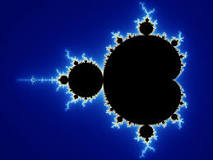
Pretty soon, we’ve got some really meaty mathematical structures such as Mandelbrot’s Set* and, in particular, Schrodinger’s Equation:
![{\displaystyle i\hbar {\frac {\partial }{\partial t}}\Psi (\mathbf {r} ,t)=\left[{\frac {-\hbar ^{2}}{2m}}\nabla ^{2}+V(\mathbf {r} ,t)\right]\Psi (\mathbf {r} ,t)}](https://wikimedia.org/api/rest_v1/media/math/render/svg/4894f9a205c471cb012351a1fccdd01285b6f11c)
All this happens in the blink of an eye – more or less instantaneously – let’s call it the “Big Bang”!
Then a miracle happens: all this maths somehow “coalesces” or “crystalizes” into a vast soup of quantum objects which we can think of either as waveforms, defined by various forms of Schrodinger’s equation, or as the potentiality (an infinite network of probabilities) of various elementary particles – photons, electrons, quarks etc. In other words we have created the “quantum world”; (note that, instead of using the term “think of”, I could have said that we can model the the quantum world either in terms of waves or particles).
The rest is fairly straightforward. The particles combine to become protons, neutrons, atoms, molecules and all the elements of what we call matter in the physical world (and presumably other quantum objects become energy: heat, light, electromagnetic radiation etc) ; all this stuff clumps together under gravitational forces into galaxies, stars, planets; on one planet life emerges; the human brain evolves, and we have consciousness. Simples!
Let’s go back to where the miracle happens. There’s actually two rather tricky steps here (for the time being I’m treating the 0 = 1 – 1 bit as more or less an act of faith!):
Step 1: Information becomes the quantum world (strictly speaking I’ve only been talking about mathematics, but if this process works for maths then it seems reasonable to suppose it works for any type of information).
Step 2: The quantum world becomes the physical world, which we know and understand through the laws of classical physics and which exists “out there”.
Having read Philip Ball, I’m now fairly comfortable with Step 2. If I understand him correctly, recent advances in quantum science now mean we can think of the physical world as being a special case of the quantum world. Weird things like superposition and entanglement really are the way things are, and the only reason we don’t notice them at the human scale is because in practice any simple quantum system is surrounded by so much “environment” (heat, light, other particles etc) that its waveform “collapses” almost immediately, and through processes known as “decoherence” and “quantum Darwinism” we see what we see. In particular, it seems we no longer need to get hung up on Schrodinger’s wretched cat and the idea that our observing or being conscious of the physical world somehow brings it into existence. Similarly, we probably don’t need to worry about “spooky action at a distance”, or the quantum world constantly splitting into an infinite number of “multiverses” with different versions of me. So that’s a relief!
Part 1 of the miracle is admittedly more difficult to swallow. The trouble is that information is, or appears to be, extremely slippery, ethereal stuff. It is difficult enough to imagine it floating about, out there, in the absence of anything else, never mind eventually somehow condensing into physical objects we can see and touch. But Philip Ball, like Wheeler and Rovelli (see last post), clearly suspects that information is in some sense at the bottom of the “real” nature of the quantum world, in the same way that I’ve argued that information is fundamental to consciousness. And if, as seems the case, the mathematics of quantum mechanics is an accurate and complete description of the quantum world – in other words, a good model – then isn’t it conceivable that matter, like mind, is fundamentally just information?
Perhaps what we have here is a hierarchy of models, all based on information processing:
- Consciousness is a model of the physical world
- The physical world is a model of the quantum world
- The quantum world is a model of mathematics – in other words pure information.
But I’m still uneasy with the concept of information just being out there, floating about without any obvious substrate, such as the paper it’s written on, or a magnetic disc, or a chip in a computer. As described at length in this blog, I believe consciousness to arise out of an information model running on a substrate comprising the neurons in the human brain. The physical world is in a sense an instance, or model, of the many forms which the Schrodinger waveform might take: its substrate is the quantum world. And the quantum world is mathematics – just information – the purest and most abstract form of model imaginable. But what does it run on, what’s its substrate? The brain of God?
* Mandelbrot’s Set
 consciousnessandstuff
3 comments