Like many of my generation, I “experimented with drugs” in my youth. The most interesting was LSD. The extraordinary and sometimes scary effects of this drug are still vivid in my memory today and I believe they are explicable in terms of Model Theory.
The most obvious effect of LSD is on sensory perception, particularly visual effects. The visual world swirls about, with intense colouring and shading and a wealth of vibrant details. We can explain this in terms of a lack of the filtering of sensory input which occurs normally in visual perception, as well as a breakdown in the “constancies” which keep the visual world stable – for example the corollary discharge mechanism described in an earlier blog. In other words what we see is closer to the “real” sensory input than the idealised model of a visual scene which our brains normally construct for us. Normally if we look at a blank white wall we see just that – a wall painted white. Under the influence of LSD we see what is really there – every brushstroke, considerable variation in the shade of white from place to place, coloured shadows, and so on. Conversely, the wall is not static and stable as we know it to be in reality, but writhes about and changes shape as the various feedback and feedforward mechanisms which normally maintain visual stability begin to break down and reflect the shifting patterns presented to our retinas.
LSD also has a powerful effect on attention and engenders “heightened awareness”. You find yourself spending what seems like hours fixated on a flower or a blade of grass, marveling at its significance and beauty. As we have seen, in terms of Model Theory, attention is the mechanism which we use to test out hypotheses about the outside world and our place in it. LSD’s effect is not so much on attention itself, which if anything is intensified, but more on our ability to shift attention.
The distortion of sensory perception together with attentional effects, heightened awareness and indeed heightened emotions often combine to give a sense of “oneness with the universe”, sometimes tellingly referred to as “ego-death”. This immediately suggests a breakdown not just of the mental model in general, but also specifically of the self-model which we have argued is the basis of our sense of self-consciousness. In a sense we are bypassing the mental model and experiencing the world more directly – what Metzinger would call a breakdown in the “Transparent” nature of consciousness. The effect is (I imagine) very similar to a religious experience, something else which Model Theory can potentially address.
It appears that LSD works by interfering with the effect of the neurotransmitter serotonin or 5-hydroxytryptamine. This makes sense when you compare molecular structures.
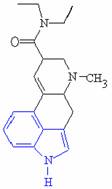
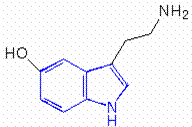
LSD Molecule Serotonin Molecule
That leads to the prediction that serotonin plays an important role in the functioning of the mental model. For example based on the effects described above, we would expect it to be active within visual cortex (visual distortions) and pre-frontal cortex (attention and self-consciousness). Assuming serotonin has a predominantly inhibitory effect, LSD would act primarily by inhibiting this inhibition – a general excitatory effect.
One other striking effect of LSD is that time seems to slow down. I’m not sure how that fits in with model theory. In one sense, this maybe just reflects that so much goes on while the drug has its effects that a “trip” of eight hours or so seems to last for days, in retrospect at least. But maybe there is an explanation in terms of the running of the model. Computers all have a “clock” which keeps the steps in a program in synch – the faster the clock, the more powerful the computer. Maybe the mental model has a similar clock, intimately involved with our perception of time. More on this in later blogs perhaps.
 consciousnessandstuff