I don’t think anyone reads J W Dunne any more, but he was very popular in the 1930s and published two rather remarkable books. In “An Experiment With Time” he claimed that our experience of time as linear is an illusion of human consciousness, and that in dreams we had simultaneous access to past, present and future. In “The Serial Universe” he extended this argument to accommodate the then quite recent findings of quantum physics and relativity, and concluded that we are immortal!
Personally, I don’t buy these claims. I haven’t read Dunne sufficiently carefully to be able to offer a definitive refutation, but my instinct is that precognition and immortality are just plain wrong.
Dunne did have an insight, however, which I suspect is crucial to the understanding of human consciousness: namely, the idea of an infinite regress.
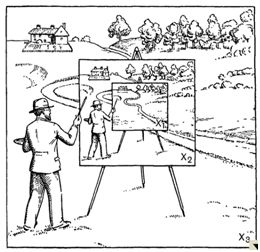
An infinite regress is a series in which the truth of a term N is dependent on the truth of term N+1 and so on to infinity. They are generally regarded as bad things – if you find yourself resorting to explaining a phenomenon in terms of an infinite regress you are generally regarded as having failed. Dunne, if I understand him correctly, challenged this dogma – infinite regresses crop up in all sorts of situations and we just have to accept that they are a “real” feature of our universe. Moreover, he pointed out that in any such series, it is only when we get to the second term that we reach a full understanding of the phenomenon under investigation. For example in the series child – father – grandfather – greatgrandfather, and so on, it is only with the second term that we get the essential property that each term is both a father to the preceding term and a child of the next term.
In consciousness debates, an infinite regress is associated with the familiar and much derided idea of a “homunculus”, or “little man” who watches a screen on which is projected an image of the outside world, and is in turn watched over by another little man, and so on ad infinitum.

Ridiculous, obviously! Or is it? Actually, it feels to me as if something like this is going on, and it fits in with what is known about the active nature of perception and the phenomenon of selective attention. If I look out the window, I’m aware of the scene outside, but I’m also aware I’m looking at the scene, and I’m aware that I’m aware, and so on. And if this goes on to infinity – so what – at least we’ve captured the recursive quality of consciousness as involving something which is both observing and being observed simultaneously. We’ve also captured the idea of the self as a “model within a model” which can selectively observe different aspects of the model of the outside universe.
 consciousnessandstuff
A lot of people are still reading and talking about Dunne. His ideas appear to be immortal, whether he is or not, grin.
Modern computers have highlighted another form of regress which is called virtualization – a virtual computer running inside a real computer and, in its turn, running another virtual computer inside itself. People have sometimes stacked one computer inside another inside another and so on just to see how far they can push the game. I think this may be a better model for our “thinking about thinking” recursions than Dunne’s independent levels of existence.
Thanks Guy. Interesting insight. Maybe if there was some sort of feedback between all the virtual computers they’d become conscious! I see you’re writing a biography about Dunne – impressive!