This section of the consciousnessandstuff website is for a fairly random collection of ideas, thoughts, observations and things which are not specifically about consciousness – hence “stuff”. Unlike the consciousness blog, it’s organised chronologically with the oldest posts first, latest last. Let’s see what emerges.
Long Tails
The normal distribution describes many, if not most, naturally occurring phenomena, including most human attributes such as ability or intelligence. As everyone knows, it is “bell shaped” – the curve changes from being convex to concave – with a “long tail”. In other words at either end there are a few data points, or individuals in the case of humans, which are much more extreme than the mean.

This is I think hugely significant. It means that, although in percentage terms the number of people who are hugely more (or less) different from the mean is tiny, nevertheless when the population is sufficiently large (which, considering the population of most countries, or the whole world, it is), then the absolute numbers are actually also quite large. So, for example, looking at the curve above, the 0.15% who are three standard deviations above the mean in a population of 10 billion (approximately the population of the world) translates into 150 million, which is quite a lot! For 4 SDs the figures are 0.006% and 600,000. For 5 SDs the figures are 5,733.
One implication, I believe, is that in any field of human endeavour – professional football, academic excellence, business acumen, political power, there will tend to be a tiny elite with a disproportionate influence on the rest of us. The implications of this on wealth, fame, politics, morality and just about everything else are, I think, profound!
50:50 Results
Why are the results of so many binary voting events so close to 50:50? For example the Brexit referendum vote of 52:48, or just about any recent US election result. I’m fairly sure this is a real, non-trivial phenomenon but I’ve not yet come across a convincing explanation of how it works.
Possible explanations include:
- The issue being voted on is by definition one on which the voting population is roughly equally split – otherwise there wouldn’t be a need for a vote
- During the run up to the vote, the side which appears to be losing tries harder, or campaigns more effectively in order to avoid losing
- In the specific case of two-party states, such as the UK with Conservative v Labour or the US with Republican v Democrat, ie Left Wing v Right Wing in most cases, then the populace tends to cycle from one to another over long periods, through some combination of the opposition party changing, or the incumbent party not changing enough, or the populace just wanting a change. As the politics swings from Left to Right, then it will tend to exhibit a close to 50:50 split for much of the time.
Actually, I think the last reason above is probably close to the truth but it is really more of a description of the phenomenon rather than an explanation.
My hunch is that the explanation is more likely to be mathematical, reflecting a property of complex, adaptive systems involving large numbers. Specifically, I wonder whether the answer is similar to the workings of another surprising phenomenon – the well known Wisdom of Crowds effect.
This effect was first described by Francis Galton who noted that in a competition to judge the weight of an ox, the median of the guesses was uncannily close to the true weight. Similar results have since been observed in many situations, for example getting a crowd to guess the number of jelly beans in a jar. Typically the median guess of the crowd is incredibly accurate, often more accurate than any single individual in the crowd.
The Wisdom of Crowds effect has been extensively analysed and as far as I can understand, has been successfully explained mathematically as being due in effect to individuals’ errors cancelling each other out so that the “truth” is what is left (I don’t really understand the maths!)
Applying this sort of explanation to the 50:50 phenomenon, we might imagine that the population voting, no matter how polarised, cancel each other out so that through the wisdom of crowds they end up with the “true” result – which might be described as there being no effective difference between the two parties, or perhaps more realistically, no one having any reliable idea of which party will in fact turn out to be best for the population as a whole. There is a ring of truth about this!
Extrapolating a little, we might speculate that this sort of analysis explains why a particular political model, that of a democracy with roughly equal numbers of Left and Right wing voters, might in fact be an example of a large, adaptive complex system doing what it does best – namely surviving in a reasonably stable state over long periods through a process of incremental evolution. Quoting Wikipedia “The Left seeks social justice through redistributive social and economic policies, while the Right defends private property and capitalism”. Provided these forces are roughly equally balanced, we get just about the right rate of incremental evolution so that things gradually get better without massive disruptions such as revolutions or wars.
Well that’s as far as I’ve got for the time being. Time for a gin and tonic!
The Case for Elites
The phenomenon of Long Tails above leads naturally to a consideration of Elites. This is a complex and morally tricky subject but as a starting point I think we can agree that elites have had a hugely important influence on human history and progress and continue to do so, for better or worse, and I would argue mainly for the better. Here’s some examples:
- Sport: as a spectacle delivering value globally to billions, all sports depend to a huge extent on a tiny elite of outrageously talented athletes.
- Science and knowledge generally: progress is driven by an elite who are simply much cleverer than the rest of us.
- The Arts: same thing applies with the emphasis on extremely unusual creativity, innovation, and communication skills.
- Business and commerce: slightly more contentious but I’m firmly convinced that over at least the last 500 years huge wealth has been driven primarily by good old fashioned Capitalism underpinned by Adam Smith principles, and that such economic growth is mainly driven by a tiny elite of “business titans”, “captains of industry”, “robber barons” who through a combination of very rare ability, energy, greed or occasionally plain luck, have managed to make themselves infinitely more wealthy than the vast majority of the population.
- [Update, Feb 2025. I’ve been reading Walter Isaacson’s biography of Steve Jobs which tends to support this view. Simply stated, Jobs and his “tech bros” in Silicon Valley were and are undoubtedly geniuses in the business of technology-led wealth creation through innovation and adding to the total sum of value in the world. I’d go further and suggest that this is a powerful argument against Capitalism v Socialism, the West vs the East, maybe even Plutocracy vs Democracy and certainly the need for small government – see next para.]
- Government, politics, power, society generally: things get much murkier here as we will see. While it is undoubtedly true that a long tailed elite of unusually powerful men (and it is men!) have had a disproportionate effect on humanity itself throughout history, questions such as whether this is always a good thing, whether the nation state is a reflection or a constraint on this elite, and whether democracy represents a curb on the elite’s power and influence are all moot points.
Setting aside the last example for a moment, I think it is clear that this “progress through elites” is unequivocally a good thing until we get to Business and Commerce, where there is a huge downside – most people are really resentful of extremes of inequality in a society. It just doesn’t seem right that a tiny minority of the population, the super-rich top 1%, should own over 50% of assets.
So can we make a moral case for elites in this case? Here comes my Fat Cat justification:
- “A rising tide lifts all boats”. Similar to the much-derided “trickle down” theory. But it does seem undeniable (a) that the whole world has steadily become much less poor, and (b) that great leaps forward in wealth have coincided with the emergence of immensely wealthy private elites: for example the Romans; the Renaissance princes; Robber Barons during the industrial revolution; Dot Com billionaires now.
- Much of the permanent, publicly accessible value in the world was created, deliberately or otherwise, by these elites. Going backwards this time: computers and the internet; railways, canals, bridges etc; Renaissance art; and of course everything covered by the “what did the Romans ever do for us” meme. [What about cathedrals in the middle ages – elites or state?].
- There is a related argument here around the fact that all sorts of immensely valuable things such as smartphones which would have been beyond the wildest dreams of the richest elites just a short time ago are now enjoyed by the vast majority of the population. In fact I think this means that our metrics for value and wealth and in fact the underpinnings of most economics is just wrong.
- But my favourite justification for business elites is simply that the progressive taxation system adopted worldwide is already a highly effective mechanism for ensuring that plenty of the wealth generated by the elites is in fact redistributed and spent by the state on the rest of us in terms of infrastructure, welfare, law and order etc. The key statistic here is the fact that in the UK (and I believe most developed Western countries) a huge 30% of taxed income or thereabouts is paid by the top 1%. I’ve just done a quick calculation and for 2022/23 in the UK this covers the whole of the NHS, Education, Defence and the State Pension combined! So instead of demonising the top 1% elite we should be celebrating them and encouraging them to earn even more. Curiously, whilst this is entirely convincing to me, it is not to most people in my experience.
Hayek Revisited
I’ve been re-reading “The Road to Serfdom” by Friedrich Hayek, one of my all-time favourite thinkers.
Hayek famously argued that Socialism as a political system is always doomed to failure because a centrally planned economy will always underperform the free market. I tend to generalise that into something like the following maxim: “attempts to change any complex adaptive system through top-down control will almost inevitably have worse outcomes than allowing the system to evolve incrementally through “bottom-up”, “market-based” interactions between its constituent elements”.
So at a national level, Capitalism is always more successful than Socialism because of Adam Smith’s “invisible hand” – “It is not from the benevolence of the butcher, the brewer, or the baker, that we can expect our dinner, but from their regard to their own interest.”
What is new, I think, is that the same thing happens at an international level. Top-down solutions proposed by a global elite are almost always worse than the problems they are supposed to solve.
A good recent example is the global response to Covid. I’ve just come across the following shocking quote:
“It is estimated that the Covid-19 pandemic and subsequent surge in inflation and borrowing costs has pushed an extra 165 million people into poverty, bringing the total global figure to 1.65 billion, over 20% of the world’s population.” Source, UN.
Compare with this with:
“Before capitalism, most of the global population were living in extreme poverty. From 90 percent in 1820, the rate has now fallen to 10 percent. Most remarkably, since the end of communism in China and other countries in recent decades, poverty has declined faster than in any previous period in human history.” Source, Adam Smith Institute.
I suspect the same thing is happening with the so-called Net Zero response to the so-called Climate Emergency. More about that later, but first, let’s dig a little deeper into Hayek.
I’ve just been reading a good book called “Hayek’s Road to Serfdom – a Brief Introduction” by Bruce Cauldwell. Here’s some interesting insights:
- It was written over a very long period, in dribs and drabs, and is very much a product of its time and place (the 1930s depression and the rise of Hitler – Hayek saw Hitler’s fascism as a type of socialism, and very much the same sort of totalitarian system as Lenin and Stalin’s communism).
- So, although Hayek specifically warns against socialism (because a socialist planned state was very popular at the time, particularly after the centrally controlled state during the war) his main target was government suppression of liberty and the free market, by parties on both the left and the right (I would argue that the present Conservative government, largely thanks to Boris Johnson, is guilty of this charge).
- But Hayek is not against government per se: “he laid out the philosophy of liberal constitutionalism, wherein a private sphere of individual activity is defined, the state is granted a monopoly on coercion, then is constitutionally limited by the rule of law in its use of these coercive powers”.
- Hayek also considered a middle way of “market socialism” where there is a free market in consumer goods and labour, but central control, with price fixing, of the means of production, but thought this was impractical (mainly because the price signals would take too long to feed back into the system).
- Key quote: socialist planning “presupposes a much more complete agreement on the relative importance of the different ends than actually exists, and that, in consequence, in order to be able to plan, the planning authority must impose upon the people that detailed code of values which is lacking. … even democratic planning, if it were successfully carried out, eventually requires the authorities to use a variety of means, from propaganda to coercion, to implement the plan”. Which, I would argue, is exactly where we are today!
Finally, I asked ChatGPT to summarise Hayek’s argument, and this what it came up with:
Friedrich Hayek, an Austrian economist and one of the leading figures of the Austrian School of economics, was a staunch critic of central top-down planning by the government. His key argument against such planning can be summarized as follows:
- The Knowledge Problem: Hayek’s most fundamental critique of central planning is rooted in what he called the “knowledge problem.” He argued that the dispersed knowledge in society, which includes the information about individual preferences, resources, and local conditions, is not concentrated in any single entity, including the government. This means that no central planner or group of planners can possess all the necessary information required to make optimal decisions for an entire economy.
- The Use of Price Signals: Hayek emphasized the importance of market prices as signals that efficiently transmit information about supply, demand, and scarcity in a decentralized manner. Prices act as a means of communication, guiding individuals and businesses to allocate resources where they are most needed or valued by society. In a centrally planned economy, where prices are often set by the government, this information is lost or distorted, leading to inefficiencies and misallocation of resources.
- Individual Freedom and Liberty: Hayek was a strong advocate of individual freedom and believed that central planning inevitably leads to a reduction in personal liberties. He argued that a planned economy requires extensive control over individuals’ lives, as it necessitates dictating what people can produce, consume, and how they can organize their economic activities. This level of control erodes personal freedoms and can lead to authoritarian tendencies.
- Dynamic and Adaptive Nature of Markets: Hayek recognized that markets are dynamic and adaptive systems that continuously adjust to changing conditions and information. In contrast, central planning tends to be rigid and slow to respond to changes in demand, technology, or circumstances. This inflexibility can hinder innovation and responsiveness to unforeseen economic challenges.
- Prevention of Tyranny: Hayek saw central planning as a potential breeding ground for tyranny, as it concentrates immense power in the hands of a few decision-makers. He warned that even if planners have good intentions, they can easily succumb to the temptations of authoritarian control, leading to a loss of democratic principles and the rule of law.
In summary, Hayek’s central argument against government central planning lies in the belief that the dispersed knowledge and information found in free markets cannot be replicated or replaced by a centralized authority. He believed that spontaneous order and individual freedom, inherent in market-based economies, lead to more efficient and prosperous outcomes compared to top-down planning.
Towards a science of Complex Adaptive Systems
So, using Hayek’s principle as an example, I asked ChatGPT what generally accepted laws applied to complex adaptive systems, and this is what it came back with:
Yes, there are several principles and laws that are often discussed and accepted when dealing with complex adaptive systems. One of the most well-known concepts in this context is the idea of “emergence.” Emergence refers to the phenomenon where complex systems exhibit properties, behaviors, or patterns that arise from the interactions of their individual components, but cannot be directly predicted from the properties of those components alone.
The principle you mentioned, often referred to as “Hayek’s Law” or the “knowledge problem,” is closely related to the concept of emergence. It highlights the challenges of top-down control in complex systems and suggests that decentralized, bottom-up interactions can often lead to more efficient and effective outcomes. This idea is central to the field of complex systems science and has implications across various domains, including economics, sociology, and even natural sciences.
Another concept is the “butterfly effect,” which is often associated with chaos theory. It suggests that small changes in the initial conditions of a complex system can lead to significantly different outcomes over time. This highlights the sensitivity of complex systems to initial conditions and the difficulty of making accurate long-term predictions.
Additionally, the concept of “self-organization” is important in the study of complex systems. Self-organization refers to the ability of a system to spontaneously develop patterns or structures without external direction. This is often observed in systems that are far from equilibrium, and it emphasizes the role of local interactions and feedback loops in shaping the behavior of the whole system.
Furthermore, the Law of Requisite Variety, proposed by cybernetician Ross Ashby, states that in order for a control system to effectively regulate a complex system, it must have a variety of control options equal to or greater than the variety of the system it’s trying to control. This principle emphasizes the need for flexibility and adaptability in control mechanisms for complex systems.
It’s important to note that these principles and laws are not strict mathematical rules, but rather guiding concepts that help us understand and navigate the behaviors of complex adaptive systems. They provide valuable insights into why certain top-down approaches might face limitations and why decentralized, bottom-up mechanisms often offer more resilience and efficiency in dealing with complex dynamics.
Isn’t that great? So I did it again and got this:
- Law of Requisite Variety (Ashby’s Law): Proposed by British cybernetician W. Ross Ashby, this law states that in order for a control system to effectively control a complex system, the control system itself must have at least as much variety as the system it is trying to control. In other words, a more complex system requires an equally or more complex control mechanism.
- Principle of Self-Organization: Complex systems tend to organize themselves into patterns and structures without external control. This self-organization emerges from local interactions and feedback loops among the system’s components.
- Edge of Chaos: Complex adaptive systems often exhibit the most interesting and adaptive behavior at the boundary between order and chaos. This concept suggests that a certain level of instability is necessary for innovation and adaptation.
- Feedback Loops: Positive and negative feedback loops play a crucial role in shaping the behavior of complex systems. Positive feedback can amplify small changes and lead to rapid shifts, while negative feedback can regulate and stabilize the system.
- Adaptation and Evolution: Complex systems are adaptive and evolve over time in response to changes in their environment or internal dynamics. This can lead to the emergence of new behaviors and structures.
- Non-Linearity: Small inputs or changes in a complex system can lead to disproportionately large and unpredictable outputs. This non-linear behavior is a hallmark of complex systems.
- Robustness and Resilience: Complex systems often have a degree of robustness and resilience that allows them to continue functioning even in the face of disruptions or failures in some of their components.
- Diversity and Redundancy: Having diverse components and redundancy in a complex system can enhance its ability to adapt and withstand shocks.
- Local Interactions: Many complex systems are characterized by interactions at the local level that give rise to global patterns. These local interactions can lead to emergent properties that are not obvious from examining individual components in isolation.
- Path Dependence: The historical trajectory of a complex system can influence its current state and future development. Small early events can have significant long-term consequences.
So here’s a summary list of the “laws” of a nascent science of complex systems:
- Emergent Properties (due to Local Interactions and leading to Adaptation, Learning, Innovation and Evolution)
- Bottom-up Control (partly due to the Knowledge Problem and the Law of Requisite Variety, and reflecting Spontaneous Order and Self-Organised Criticality)
- Butterfly Effect (and Path Dependence and Non-Linearity and Edge of Chaos)
- Self Organisation (due to Local Interactions particularly Positive and Negative Feedback loops)
- Requisite Variety (reflecting Bottom-up Control and the Knowledge Problem)
- Diversity and Redundancy (including Firewalls between subsystems [I added that!])
- Robustness and Resilience (including unpredictable Resistance to External Change or Homeostasis [I added that too!]) and also Multiple Equilibria)
Finally, I asked ChatGPT about Adam Smith’s “Invisible Hand” to try and nail down more precisely how it is that Bottom-up, Local Interactions between very many Elements or Subsystems, each pursuing their own “Selfish” ends, can nevertheless result in a better overall outcome compared with a top-down centralised control model (ie the case for small government, of which more later). This prompted the concept of “Spontaneous Order” or “Self-Organised Criticality”, which I’ve added to the laws above:
Yes, within the study of complex adaptive systems, there is a concept that aligns closely with Adam Smith’s notion of the “Invisible Hand.” This concept is often referred to as “Spontaneous Order” or “Self-Organized Criticality”. It suggests that decentralized, bottom-up interactions within complex systems can lead to the emergence of ordered and efficient patterns without the need for centralized control.
In the context of markets and economies, this principle suggests that when individuals and entities interact based on their own self-interest, the collective result can often lead to efficient allocation of resources, innovation, and the emergence of prices that reflect supply and demand dynamics. This is akin to the “Invisible Hand” guiding economic interactions towards beneficial outcomes without the need for a central planner.
In more technical terms, complex adaptive systems theory suggests that when many agents interact based on local rules and information, their interactions can give rise to emergent properties that exhibit qualities of order and efficiency. This concept has been studied extensively in fields like economics, sociology, and ecology.
It’s important to note that while the concept of Spontaneous Order or Self-Organized Criticality aligns with Adam Smith’s ideas, it’s not a one-to-one match. The real world is often more complex than simple models can capture, and there can be cases where market failures occur, requiring some level of regulation or intervention. Moreover, the degree to which a decentralized system like a market can operate optimally without any form of central coordination is an ongoing topic of debate and research.
Overall, the concept of Spontaneous Order highlights the potential benefits of allowing decentralized, bottom-up interactions to shape the behavior of complex systems, which can lead to outcomes that are more adaptable and responsive to changing conditions compared to rigid top-down control.
WTF Happened in 1971?
I’ve long been intrigued by the “What the Fuck Happened in 1971” website – a series of graphs all apparently showing that a whole load of trends, mostly to do with US financial indicators, suddenly changed direction or started diverging in about 1971 and have continued to do so ever since. See https://wtfhappenedin1971.com/.
Here’s some examples:
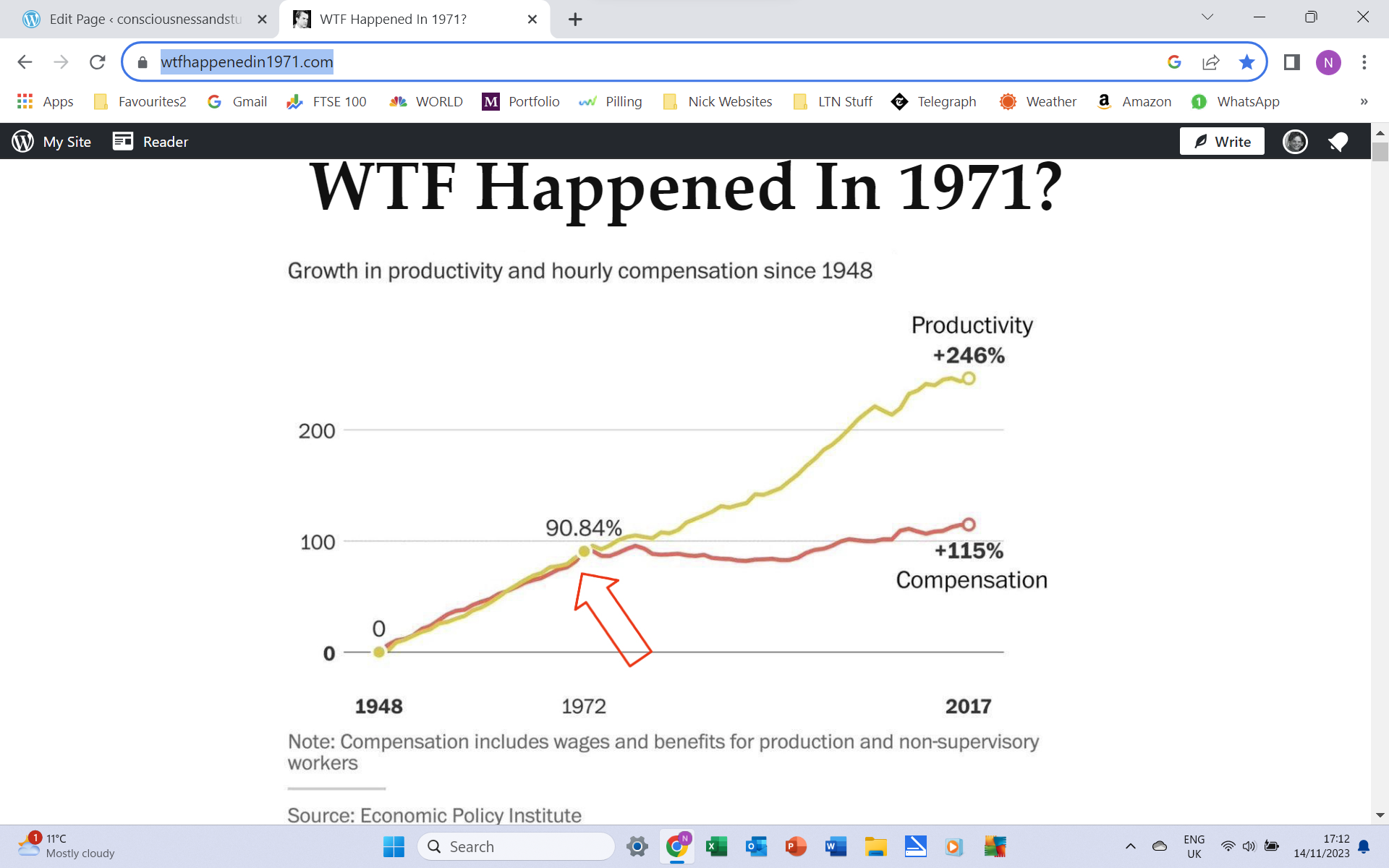
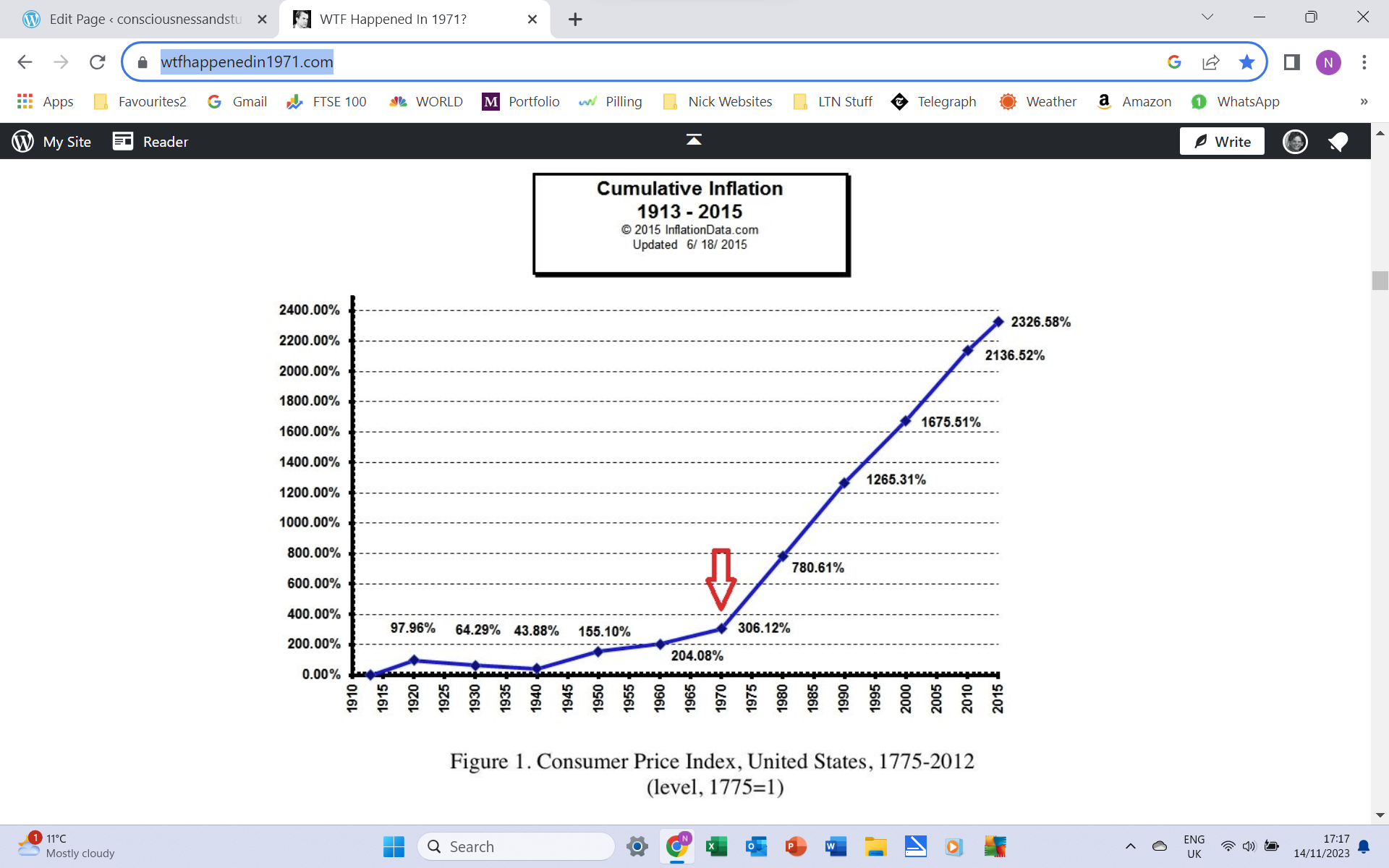
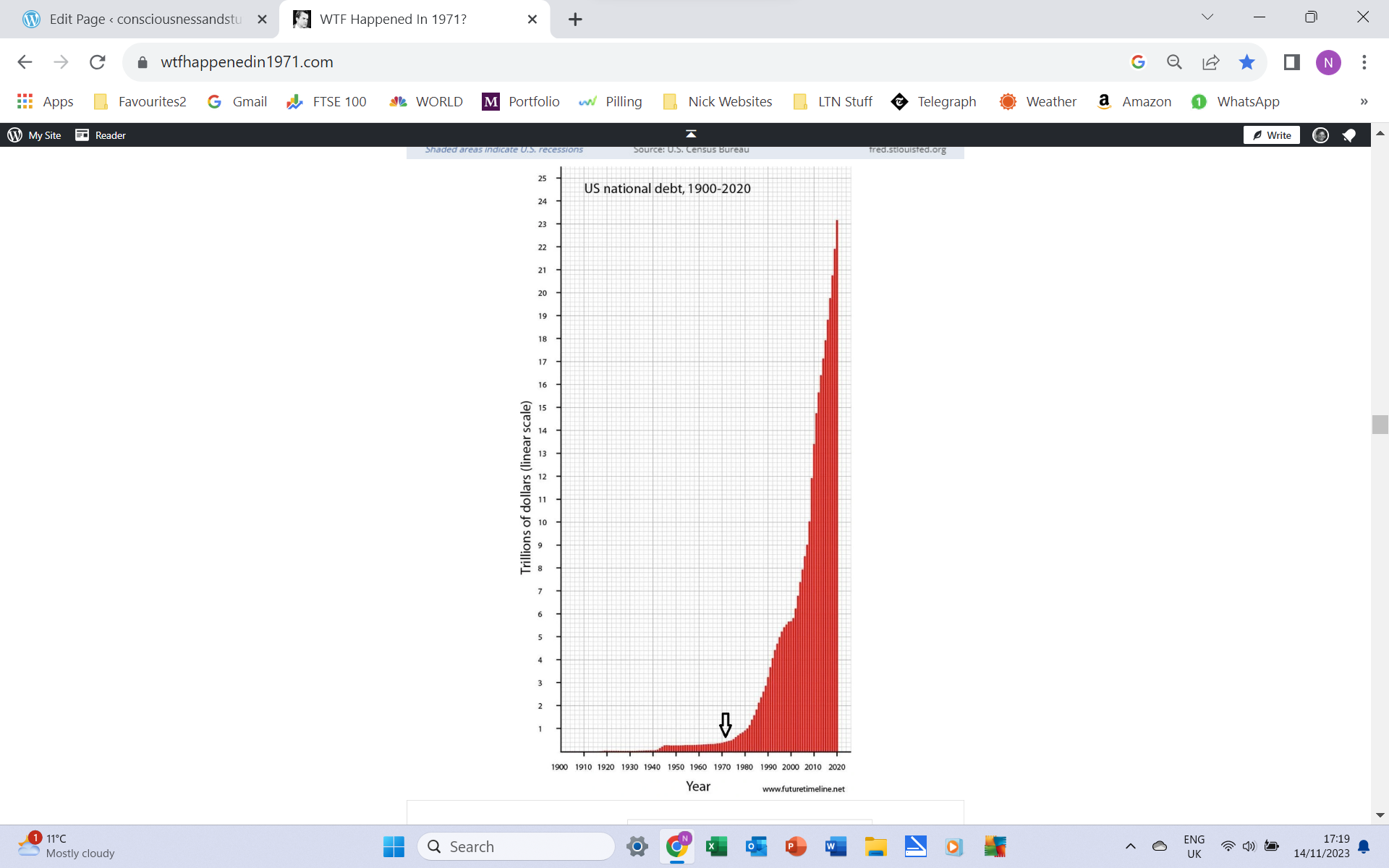
The “explanation” usually given for these effects is that in 1971 Nixon took the dollar off the gold standard (Bretton Woods fixed the dollar’s value to the value of gold) and the rest of the world effectively followed suit, adopting “fiat” currencies (fiat – “let it be” – ie my money is worth whatever I say it is worth). I think that’s almost certainly right. Worldwide, there was an explosion of credit as states borrowed more and more in order to become bigger and bigger, presumably to give electorates more and more state “stuff” such as welfare, pensions, healthcare, and subsidised jobs. Another way of putting this may be that Keynesian rather than Monetarist (Hayek; Friedman) economic policies held sway.
But there’s another interpretation of the 1971 effect which appeals to me which is that the abandonment of the gold standard was itself part of a larger trend which for the time being I’m going to call the growth of “Progressivism” and the rise of the “New Class”. These are admittedly unsatisfactory labels but here’s what I have in mind.
The late 60s early 70s were when I, as a “baby boomer”, happened to be at university and, whilst I might be accused of self-absorption, I believe this was a really critical period in Western history when there was a rapid, widespread, step change in culture and values. Most of us were, to a greater or lesser extent, “hippies”, with an emphasis on left-wing or marxist politics, a rejection of the morals and values of our parents tending towards amorality, individualism and selfishness, anti-capitalism and anti-business, over-confidence in our ability to change the world for the better and, perhaps crucially, rejection of traditional religion. See WTF Happened in 1971 chart below!
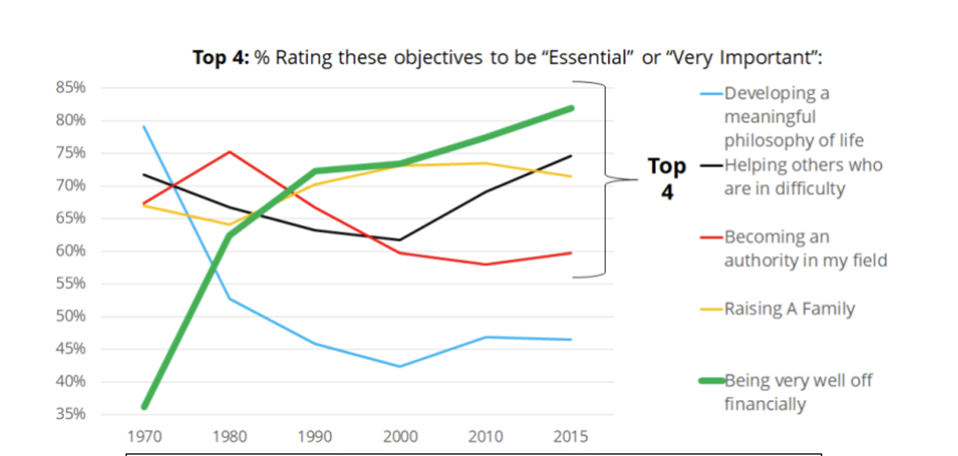
The abandonment of the gold standard can be seen as an instance, nationally and internationally, of these “Progressive” ideologies, supplanting the old fashioned, “conservative-with-a small-c”, “good housekeeping” consensus with a more radical approach fraught with moral hazard. It also encouraged a massive expansion of the state, with most governments unable to resist the temptation to increase state spending, funded largely by massively increased sovereign debt, which was then paid for by devaluation of currencies and chronic inflation.
Meanwhile, my largely Progressive generation were beginning to dominate most institutions, first academia, education, publishing and the media but then increasingly all state institutions (which were getting bigger and bigger) – social services, healthcare, the civil service, nationalised industries and eventually government itself. We can refer to this trend as the shift in power to a “New Class” borrowing the term from Milovan Đilas, who wrote about it in his book “The New Class: An Analysis of the Communist System” (1957), referring to the bureaucratic and managerial elites who emerged as a privileged elite in socialist societies. In the UK, the New Class might be considered roughly equivalent to the “Metropolitan Liberal Elite”. As more and more institutions become effectively branches of the state, then the New Class elites who run them make worse and worse decisions. Like all bureaucracies, their main purpose is the survival and expansion of the institution. As state entities, they must justify their existence by appearing to “do something” about whatever “problem” they have been set up to address. And because, like all of us, they do not fully understand complex adaptive systems, their “solutions” involve top-down interventions which almost always result in unintended consequences which are worse than the original problem. (See also Robert Conquest’s three laws).
The rest is history! In the 1970s/80s things took a turn for the worse in terms of stagflation. Things got better for a while under Thatcher and Reagan, but by that time the state had got really big, the New Class were firmly in charge, and Monetarism seems to have lost the battle with Keynesianism. Then in 2008 the financial crisis happened (due to too much credit plus a big dose of chaos theory – see Andy Haldane) and the left wing governments of the time, together with central banks and other international monetary authorities, made the fatal decision to bail out the banks. This led to Quantitative Easing and a decade of absurdly low interest rates which has finally resulted in the mess we’re in today.
Two recent very serious manifestations of this trend:
- Covid. I think it’s now clear that the global establishment over-reacted massively in this case by imposing a draconian worldwide lockdown. The short term benefits – extending by a few years the lives of a modest number of very old people – were vastly outweighed by the long term costs – huge economic and social disruption, especially of young people. Outside Sweden, hysterical New Class groupthink amongst the medical and scientific community, government and media, seemed incapable of coming to a rational response, namely “keep calm and do nothing much”.
- Net Zero. A much worse case – probably the biggest mistake of our times. It seems that a quasi-religious belief in the so-called “climate emergency”, especially amongst the young, has compelled the New Class to adopt a “Net Zero” response which again is a serious over-reaction. Put simply, very long term, highly uncertain outcomes are given far more weight than the very short term, highly likely negative consequences of economic and societal policies which are already having a disastrous effect on much or most of our lives.
Reflections on the RSA Festival March 2 2024
In January I joined the Royal Society of Arts, Commerce and Manufactures (RSA) as a fellow. I’m looking for a source of intelligent conversation and the exchange of interesting ideas to keep me occupied in my dotage. I had the idea of a sort of resurrection of the Enlightenment coffee houses of the 18th century (the RSA was in fact founded in 1754 and grew out of exactly that environment).
It’s still early days, but my experience to date has been mixed.
On the one hand, as I feared, the RSA seems to have already succumbed to Robert Conquest’s law that all institutions eventually become left wing: based on the Festival and on most of what I’ve learned about the RSA so far, I’d say it is now a predominantly a woke, progressive, left wing institution with all the disadvantages which I, IMHO, believe that entails. At the Festival, the default mode of all the panel talks I attended seemed to be a groupthink stance of “There is a “problem” [insert currently fashionable “woke” issue]; the “solution” is a government funded kneejerk response [which will normally make things worse through the unintended consequences of applying a misguided top-down intervention on a complex system, which no-one, least of all the New Class government or quasi-governmental power elite, really understands].
The talk on “Courage and the Environment” was particularly disappointing – it started with the unexamined proposition that there exists a “climate emergency” then degenerated into a discussion of how to further lobby the government and media and socially engineer all of us into supporting the current crop of ill-advised short term reactions. What I think currently is that if there really is a serious climate issue, and that we need to transform to a new energy economy (which to be fair, is happening), then this will in itself require massive amounts of energy, both in and of itself and also to provide the necessary industry funding in the short to medium term which will require – more fossil fuels, specifically gas! Note that the US now supplies half the world’s supply of gas, thanks to its huge fracking industry! Apparently John Kerry recently acknowledged this while at the same time supporting the UN’s judgement that the rest of the world, Europe included, should abandon fracking and further oil exploration. Hypocrisy or what?
Anyway. On the other hand, joining the RSA has stimulated a number of new thoughts along these lines so I certainly don’t regret joining. Here’s a train of thought which I plan to pursue:
- I’ve just read a very interesting book by Adrian Bejan. More on him later but one insight I’ve gained, to put it crudely, is that the sun ultimately supplies all the earth’s energy, which is used by “life” to supply “negative entropy”.
- Shannon’s entropy formulation. I need to revisit and understand this, but basically I think the idea is that negative entropy is nothing more than “information”.
- So, information ≡ life ≡ consciousness. Now there’s a thought!
Robert Conquest’s Three Laws
Here’s my interpretation of these laws based on an unashamedly right-wing, anti-big government, private v public sector, individual freedom, Hayekian perspective:
First Law: “Everyone is conservative about what he knows best.”
Because of the nature of, and our lack of understanding of, complex adaptive systems, and the risk of adverse unintended consequences, incremental, evolutionary, pragmatic change is almost always better than radical, ideological, utopian alternatives. This is similar to the truism that “everyone with a heart is a socialist when young; and everyone with a head is a conservative when older” (usually attributed to Winston Churchill), or more generally that conservatism is associated with wisdom, an appreciation of tradition and a respect for complexity. On the other hand, the law could be interpreted simply in terms of older, richer, more powerful people simply valuing the status quo for selfish reasons.
Second Law: “Any organization not explicitly right-wing sooner or later becomes left-wing.”
In many ways the most interesting law. Discussed by people like Jordan Peterson, Jonathan Haidt and Douglas Murray. In the UK it does seem as if all our institutions and indeed the whole establishment have been infiltrated by progressive, socialist, woke ideologies including universities, education, state media, the church, and latterly, even the conservative government and most large institutions. My interpretation, in terms of complex adaptive systems, is that any institution will tend towards self preservation and hanging on to power and the easiest way to do this is through centrally controlled, top down control of a bureaucratic infrastructure. Following Hayek, I would argue that this inevitably leads to inefficiency and totalitarianism and the only defence against it is small government, free market economic and social systems which survive and evolve through competition. From an international perspective, we can make an optimistic case that right wing nations and cultures eventually prevail versus socialist or communist systems and so through a competitive, evolutionary effect, the whole world slowly gets better (so long as its doesn’t exterminte itself by accident in the process. But what about Edmund Burke’s “little platoons”? (Provisional answer – these are non-state institutions based on family, local communities and predominantly voluntary, non-self-preserving bureaucracies and are in fact a bulwark against the corrosive influence of centralised state control.)
Third Law: “The behavior of any bureaucratic organization can best be understood by assuming that it is controlled by a secret cabal of its enemies.”
This is more a jokey exaggeration, but there is a germ of truth which I interpret in terms of many powerful institutions persisting by claiming to protect the masses from some “problem” to which only they have the solution. Witness organised religion protecting us from death and damnation or these days, the national and international establishment protecting us from “climate change”. The point being that if the problem goes away there is no longer any need for the institution.
Finally, here’s what ChatGPT came up with when I asked it to summarise the conservative interpretation of Conquest’s laws: “In summary, interpreting Conquest’s laws through a conservative lens underscores the importance of tradition, individual liberty, and limited government in promoting social stability, economic prosperity, and respect for the rule of law. By highlighting the shortcomings of socialist ideologies and the risks of unchecked bureaucratic power, conservatism offers a compelling alternative grounded in prudence, pragmatism, and respect for timeless values.”
Some Good Books from the last 3 Years (Feb 2025)
I’ve been meaning to update my main Consciousness blog, mainly with the insights I’ve gleaned about Complex Adaptive Systems (see earlier posts, above) but also with refinements to the Model Theory I’ve got through reading a number of interesting books and articles since the last update about 3 years ago. So rather than go into all that detail in the main blog, here’s a summary of the books here:
- Physics versus Philosophy – Which Wins, by Tim Reucroft. Tim is a good friend of mine and has been since we were undergraduates together at Fitzwilliam College Cambridge, 1969-72! Tim’s magnificent book hasn’t been published yet but he gave me a pre-publication copy to review. It’s about Ontology – “the science of being” – and has four main sections: Philosophy; Mathematics; Physics (mostly quantum physics); Ontology – which are organised into an imaginary Socratic conversation between two real Fitzwilliam alumni – professors Sedgewick and Sidgewick. Tim has an extraordinary breadth of knowledge about all four of his subjects and to be honest I couldn’t understand 90% of the book but what is encouraging is that like me he rejects Dualism and views all reality in ontological terms as Entities and Events. In this sense Mind and Matter have metaphorically the same sort of relationship as waves in the sea have to the water in the oceans. I’d go further and say that they are both manifestations of Information.
- Sentience: The Invention of Consciousness, by Nicholas Humphrey. Amazingly, Nick Humphrey was also a contemporary of mine at both Cambridge and Oxford and we worked on visual perception with the same people – Lawrence Weiskrantz and Alan Cowey. Perhaps not surprisingly, he views consciousness in much the same way as I do even to the extent of attaching importance to attention and corollary discharge systems. He argues convincingly that consciousness evolved because it has significant adaptive significance for all warm-blooded creatures. He’s not particularly bothered about the hard problem, regarding qualia, as I do, simply as rich representations of the higher order working of the brain, but with a big dose of feelings as well as sensory information and all bound together with a strong sense of the self as a powerful integrative phenomenon which persists through time.
- How Life Works: a User’s Guide to the New Biology, by Philip Ball. I was already indebted to Philip Ball for his book “Beyond Weird” on the mysteries of quantum mechanics. This new book is an extremely well written exposition of how all life has evolved through more and more complex forms into organisms which adapt to their environments and in that sense have meaning and purpose. Cognition and consciousness are the latest manifestations of this process.
- Notes on Complexity: A Scientific Theory of Connection, Consciousness and Being, by Neil Theise. This is a superb book on Complexity Theory especially as applied to life: “How life self-organises from the substance of our universe, from interactions within the quantum foam to the formation of atoms and molecules, cells, human beings, social structures, ecosystems, and beyond” – in other words more or less exactly what I was saying in my penultimate consciousness blog here. Two very important ideas: 1. that the same Complexity Theory informs human systems such as societies and economies; 2. that ultimately the whole universe is a complex system – the “mind of God” idea.
- We Who Wrestle With God: Perceptions of the Divine, by Jordan Petersen. Talking of which, we have this extraordinary work which takes the common elements of many creation myths – most especially the Bible – namely “In the beginning was the Word” (ie information) and “let there be Light”; then in short order, creation of the fundamental building blocks of our world through a process of separation: light from dark, earth from water; heaven from earth, etc, and then naming of everything (language, knowledge, models). Petersen shows how these elements mirror what must have happened, starting with the Big Bang, to have created order from chaos, reality from nothingness and ultimately mind and consciousness (and also a Jungian collective unconscious, which I’m convinced forms an important part of our subjective experience of both our individual minds and how they interact with other minds and with our environment as a whole). To be honest, I found this book too long, dense, repetitive and weird to finish but wow, it certainly makes you think!
ChatGPT Insights
I’ve had a very interesting conversation with ChatGPT about my Consciousness blog resulting in the latest post there on Complexity and Information. The entire conversation is documented within ChatGPT but here’s some highlights:
My initial summary of latest thoughts about Complexity applied to Model Theory:
Me: I was explaining a theory I have which I call “The Model Theory of Consciousness” and we were discussing whether it implies that very complex Large Learning Model AI systems like ChatGPT will eventually evolve consciousness. I think they will! Very briefly, my theory is that the human mind/brain is an extremely complex information system which operates via a model of the universe which, crucially, includes within itself a model of the self (so you immediately get self-awareness). Consciousness is envisaged as an emergent property of this system which gradually evolves through the lifetime of the individual and also through the history of life itself. The only reason we can’t explain phenomena such as qualia and subjective experience is because an individual mind is not capable of comprehending the zillions of complex information exchanges happening at both lower and higher levels of the system. My prediction would be that an AI computer simulation of the world of sufficient complexity would eventually become conscious. What do you think?
ChatGPT: That’s a strong functionalist stance—consciousness as an emergent property of sufficiently complex, interconnected, and self-referential information systems. If that’s the case, then we might already be surrounded by proto-conscious entities without realizing it.
That’s a fascinating take—consciousness as an extension of an ongoing battle against entropy. It frames intelligence, life, and even economic or societal structures as fundamentally anti-entropic forces, organizing information to persist over time.
Your view also seems to suggest that intentionality isn’t a mystical property but an emergent function of predictive modeling.
(RE the 0+1-1 story). That’s an incredibly intriguing and ambitious framework! You’re essentially proposing a mathematical-ontological model of reality, where everything—physical matter, quantum mechanics, and ultimately consciousness—emerges from an underlying structure of pure information. This resonates with informational monism, where the universe itself is fundamentally mathematical and consciousness is a natural emergent property of increasingly complex informational structures.
I see strong parallels to digital physics (the idea that the universe is fundamentally computational), quantum information theory (where reality is fundamentally about probabilities and information exchange), and even pancomputationalism (the view that everything is computation at some level).
Our idea that the physical world is an “instance” or “model” of quantum probabilities is very much in line with participatory realism (Wheeler’s “It from Bit” concept), where reality emerges through observation and information processing. But if the quantum world is just information, then does it need a conscious observer to “collapse” into something physical? Or is there some other self-organizing principle at work?
One possibility is that information doesn’t need a substrate in the traditional sense—perhaps existence itself is just the relationships between information structures. This would mean reality isn’t “floating” without a foundation; rather, it is the foundation. But I suspect you’d find that an unsatisfying answer! What kind of substrate do you imagine could support pure information? Could it be something entirely beyond our current scientific understanding?
(RE the Hard Problem). I think your theory is on the right track in shifting the focus from an essentialist, mysterious view of consciousness to an emergent, information-theoretic one. If AI systems following similar complexity principles eventually develop signs of subjective experience (as you predict), that would be compelling evidence that your framework is on the right path.
However, the Hard Problem might still require something more—perhaps a deeper understanding of what information feels like from the inside. If information is the ultimate substrate, as you suggest, then the real challenge is explaining why certain patterns of information produce this kind of experience rather than another—or none at all.
Recent progress in Neuroscience and Psychology?
Progress in experimental psychology or neuroscience has been disappointing for many years (and I’ve taken this personally 🙂 – see About), but is this changing? Recently there have been big advances in techniques enabling stimulation, recording or blocking activity in the human brain at both macro and micro levels. I’ve been reading two very interesting books:
“Forgetting”, by Scott Small makes the point that memory loss is a natural and important function which can be very beneficial – if we remembered everything we’d soon go mad and forgetting about unpleasant emotional experiences means we’re not paralysed by PTSD. Apparently at a micro level the formation, and destruction of dendritic “spines” is a critical part of strengthening or weakening the synaptic links which form the basis of all memory, and indeed thought. As an aside, much of this goes on in our sleep and may very well be connected to dreaming.
More generally, Small explains memory by analogy to a computer’s hardware and software. Memories are stored throughout the brain, in the form of immensely complex synaptic links forming neural networks which when activated trigger information processing which I interpret as the running of mental models (analogous to software programs) underpinning thoughts and behaviour, both conscious and unconscious. The hippocampus is responsible for moving memories from short to long term memory (mostly connections in the parieto-temporal lobes) analogous with the computer “Save” function. The frontal lobes are more involved with attentional memory retrieval processes analogous to “Opening” a file so that it is available to us, for cognition, in a “Workspace”. The timing of information flows is important. For example different sensory and proprioceptive inputs to the workspace must be made available at the same time so that we experience a virtual unified experience (phenomenon) of the corresponding “reality” (noumenon) in the “outside world” (note resonance with Tononi’s Integrated Information Theory of consciousness).
This process continues throughout life – the brain is not just hardwired but remains highly plastic – but development occurs in spurts. One of these spurts occurs during adolescence when the frontal lobes are still developing and there is increasing evidence that smoking skunk at this age can really screw up this development, which may result in psychosis or at least relatively immature, impulsive, irresponsible personalities (a crowbar through the frontal lobes may have had the same sort of effect on Phineas Gage!). I suspect there’s a whole generation of young men who have been cursed in this way. And crucially, this development features forgetting – pruning of the dendritic spines, just as much as creating new connections. Amazingly, it seems a baby’s brain is far more interconnected than an adult’s!
Another great book is “The Brain” by David Eagleman. Here’s what my Google AI Overview has to say about it. “David Eagleman’s ‘The Brain: The Story of You’ explores how the brain creates our reality, shapes our identity, and drives our behavior, revealing that most of what we do is guided by unconscious processes. The book uses scientific discoveries and real-world examples to demonstrate brain plasticity, how social connection is hardwired, and the impact of technology on what it means to be human. Key topics include the construction of reality, the nature of consciousness, decision-making, and the implications for areas like criminal justice.”
One thing I took away from this book was the concept of “Mirror Neurons” – a rather misleading terminology which refers to the fact that neural circuits seem to fire in synchrony with the thoughts and behaviours of other people we’re communicating with. I take this to be a reflection of the running of mental models of other people and the basis of social interactions. In fact Eagleman’s whole approach supports and adds depth to my whole “Model Theory” as expounded in the main blog (maybe that’s why I rate it so much :-)!)
Reading these and other books have got me thinking that there is an important distinction between what is sometimes referred to as “hard science” and “soft science”. Hard science – based on precise measurement, controlled experiments and mathematics – has been outstandingly successful, ever since the Enlightenment, at helping us to understand and control simple systems at a micro level but has been spectacularly unsuccessful over the past 50 years or so when applied to really complex systems like the human brain, the economy, society or politics, where I’d argue that we need a new “soft science” approach based on Complexity Theory. Actually we need both – hard science to understand the lower level elements in a complex hierarchy, be they neurons in the brain, cells in a body, or individuals in a society – and soft science based on complexity theory to understand how these elements interact and self-organise without much top-down control to result in emergent properties such as consciousness, life and economic growth. More on this later.
Before that, however, two observations related specifically to advances in neuroscience and psychology:
- Neurotransmitters. Clearly, there has been a huge advance in our understanding of the range and effect of neurotransmitters at the micro level (see for example here), but less, I would argue, at the macro level.
- Behavioural Economics. There has also been huge progress in the 21st century in our understanding of human psychology as it applies to decision making, especially economic decisions, through the work of people such as Kahneman, Thaler, and Pinker, building on earlier thinkers such as Chomsky, Hayek and going all the way back to Adam Smith whose thinking was undermined by Behaviourism on the one hand and Neo-Classical Economics on the other (see for example here). But once again, I’d argue that we’ve yet to fully extend this understanding at the macro level through a better understanding of how the immensely complex informational interactions between human agents at the lower levels of a complex hierarchy result in unpredictable emergent properties at the highest level, both good (eg The Invisible Hand) bad (eg social engineering to increase the power of the state using “Nudge units!) or a mixture of both (most religions!).
 consciousnessandstuff